


How Smart Traders Use Copy Trading to Replicate Top Strategies
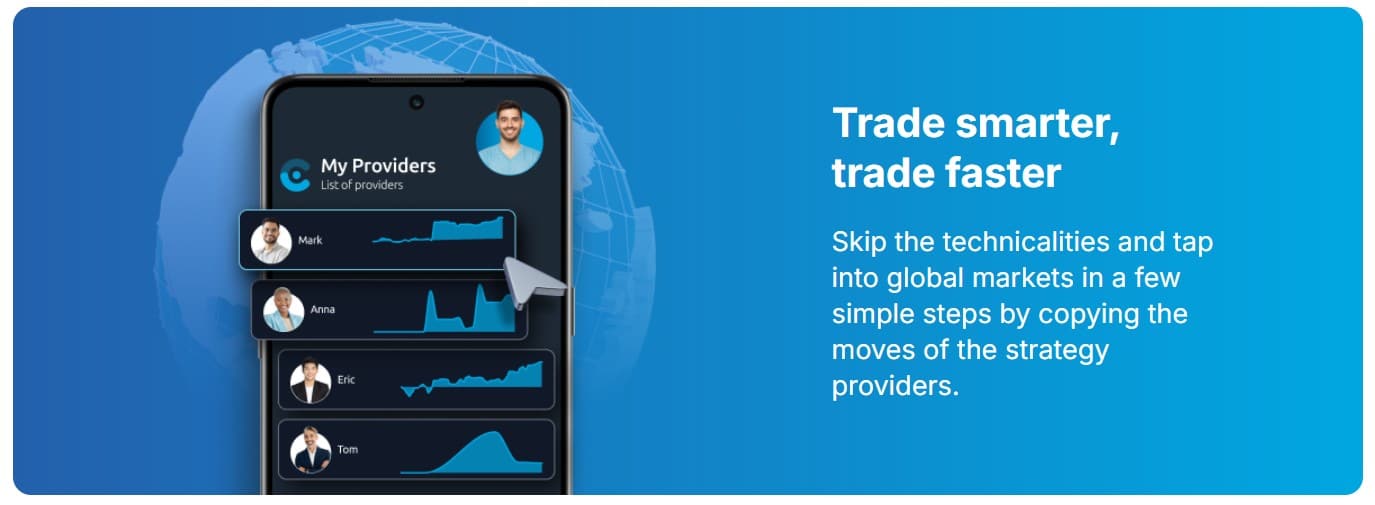
Copy trading has become one of the most popular innovations in modern online trading. At its core, copy trading allows investors to automatically replicate the trades of experienced traders in real time. Instead of manually analyzing markets and placing trades themselves, users can follow skilled strategy providers and have the same trades executed in their own accounts.
Although it may sound like a recent development, copy trading has been around for more than a decade. As financial technology evolved and trading platforms became more sophisticated, social and copy trading features that made the markets more accessible to a wider audience. What started as a niche concept gradually transformed into a powerful tool used by both beginner and experienced traders.
The impact of copy trading on the trading world has been significant. It has lowered the barrier to entry for new investors, provided transparency into real trading performance, and created a collaborative ecosystem where strategies can be shared and replicated. Traders no longer need to rely solely on theory or signals; they can observe and follow verified strategies executed by real market participants.
One of the key benefits of copy trading is automation. Once a user selects a strategy provider and configures the copy parameters, trades are executed automatically in their account. This eliminates the need to constantly monitor the markets or react to every price movement manually. Instead, the process becomes systematic, allowing traders to participate in the markets while relying on the expertise of seasoned professionals.
In essence, copy trading bridges the gap between learning and execution. It enables investors to access proven strategies while maintaining full control over their capital and risk parameters.
Does Copy Trading Work? Here’s What the Data Shows
The short answer is yes. Copy trading can work when approached with discipline and proper selection criteria. Across multiple analyses of social and copy trading platforms, the strongest findings revolve not around raw returns but around risk-adjusted performance. High returns alone can be misleading if they are achieved with excessive risk. Skilled traders distinguish themselves through consistency, risk control, and sustainable strategies rather than short instances of extraordinary gains.
Two key metrics are widely used to identify experienced and disciplined traders: Sharpe Ratio and Maximum Drawdown. The Sharpe Ratio measures the return generated for each unit of risk taken. A trader with a strong Sharpe Ratio is producing consistent returns relative to the volatility of their strategy. In other words, the higher the ratio, the more efficiently the trader converts risk into profit. Maximum Drawdown, on the other hand, measures the largest peak-to-trough decline in a trader’s account balance during a specific period. This metric helps followers understand the potential downside risk they may experience while copying a strategy. A trader who generates strong returns but regularly experiences deep drawdowns may not be suitable for conservative investors.
Risk management ultimately becomes the catalyst behind long-term success in copy trading. This is particularly important in CFD trading, where leverage amplifies both profits and losses. While leverage can enhance potential returns, it also increases exposure to market volatility. Traders who manage position size carefully and maintain controlled drawdowns are far more likely to deliver sustainable performance over time. Therefore, the goal of copy trading is not simply to chase the highest-performing trader on a leaderboard. The goal is to identify disciplined strategies that demonstrate consistency, resilience, and effective risk management.
How to Choose the Right Provider
Successful copy trading requires more than simply clicking “follow.” Smart traders approach the process with a structured selection method and strict evaluation criteria.
Start with a Verified Track Record
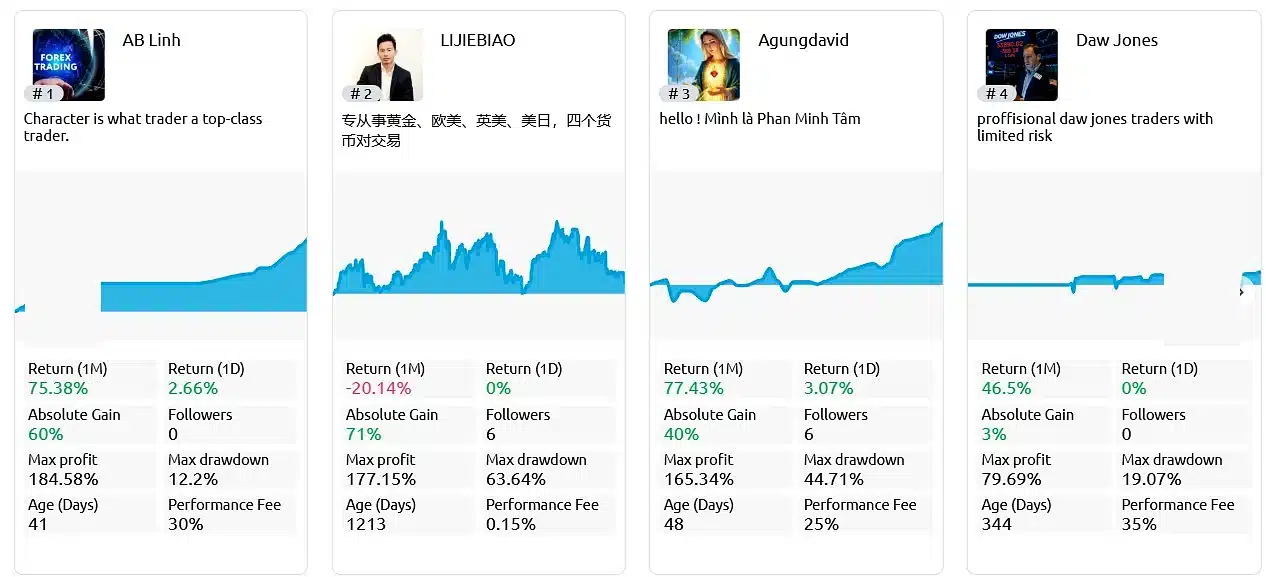
The first step is filtering traders using clear, rigid benchmarks. A reliable strategy provider should demonstrate at least six to twelve months of verified performance. Short track records, even those showing extremely high returns, should be treated with caution. Markets move in cycles, and a strategy that has only been tested in favorable conditions may not perform well when volatility increases
Evaluate Maximum Drawdown Carefully
Maximum drawdown is another critical metric to evaluate. Ideally, traders should aim to follow providers whose historical drawdown remains under approximately 25–30%. This range typically indicates a balance between risk and return while avoiding aggressive strategies that could expose followers to significant losses.
Look for a Meaningful Trading History
Another important factor is the number of trades executed by the provider. A trader with only a handful of trades may appear successful, but the limited sample size makes it difficult to determine whether their results are due to skill or luck. A meaningful trading history provides a clearer picture of consistency and decision-making ability.
Choose Consistent and Active Traders
Activity levels should also be considered. An active trader who regularly participates in the market and adapts to evolving conditions can provide more opportunities for followers. Consistency and ongoing strategy optimization are often indicators of a professional approach.
Monitor Performance Metrics Over Time
Finally, performance tracking is essential. Skilled traders constantly monitor key metrics such as Sharpe Ratio, win rate, and average profit per trade. Followers should adopt the same mindset. Regularly reviewing these indicators helps determine whether a strategy remains effective or whether its performance is deteriorating.
By applying these filters, you significantly improve your chances of identifying strategy providers with sustainable trading approaches.
Using Windsor Brokers’ Copy Trading Solution
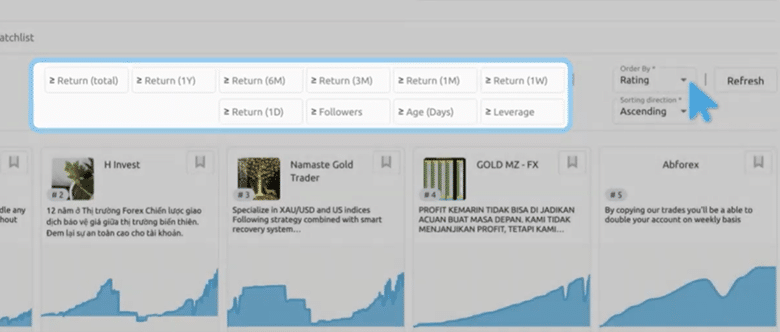
With Windsor Brokers Copy Trading, users can apply advanced filters to identify strategy providers that match their risk tolerance and trading preferences.
The platform provides transparent performance data, enabling traders to evaluate key metrics such as profitability, drawdown levels, trade history, and strategy consistency before deciding who to follow.
This filtering capability helps traders move beyond simple rankings and instead focus on disciplined strategy providers whose performance aligns with their investment goals.
Check the Strategy and Performance Fee
Before subscribing to a Provider, it is important to review their strategy description and performance fee structure. Strategy providers typically disclose the assets they trade, their trading style, and their approach to the market. Some may focus on forex pairs, while others may specialize in commodities, indices, or short-term intraday strategies. Understanding the provider’s methodology helps followers determine whether it aligns with their own risk profile.
Most providers are compensated through performance fees, meaning they only earn a percentage of the profits generated for followers. These fees typically range from 0% to 50% of the profits earned while copying their strategy. This model aligns incentives between the strategy provider and the follower: providers succeed when their followers succeed.
Follow…On Your Own Terms
Copy trading should never mean giving up control of your account. Instead, it allows traders to follow strategies while still defining how trades are executed in their own portfolios. Within the platform, users can configure basic copy parameters that determine how trades are replicated. Traders can choose whether to copy Buy trades, Sell trades, or both, depending on their preferred exposure. They can also define the minimum and maximum lot sizes they want to replicate. This flexibility ensures that the copied trades remain aligned with the trader’s risk tolerance and capital allocation strategy.
Define How Big Your Copied Trades Will Be
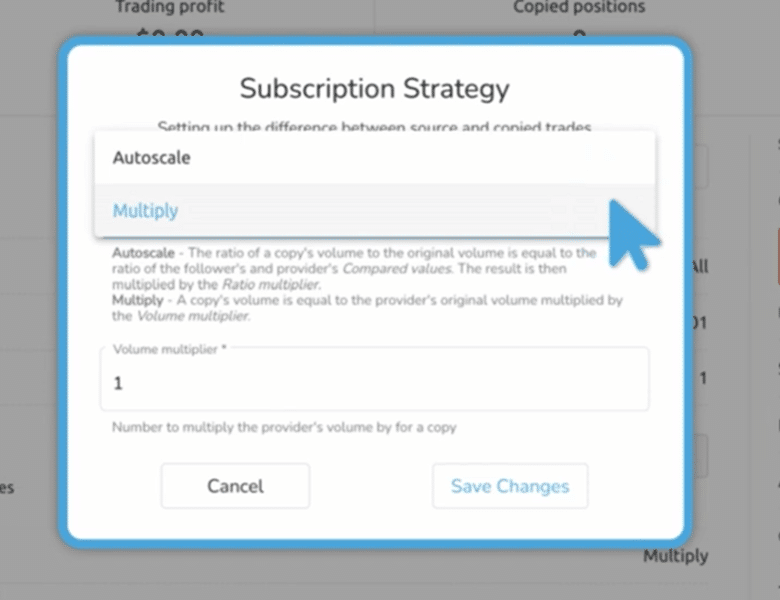
With Windsor Brokers Copy Trading, users can determine how their trade sizes are calculated through two main options.
Option A: Autoscale
Autoscale automatically adjusts position size based on the relative equity between the follower and the provider.
The compared value is set to equity by default. Users can define a ratio multiplier such as 1x, 0.5x, or 2x. The platform then compares the follower’s account equity to the provider’s equity and scales trades accordingly.
This method ensures proportional exposure, allowing smaller accounts to mirror larger strategies while maintaining balanced risk.
Option B: Multiplier
The multiplier option allows traders to directly scale trade volume. For example, a multiplier of 1 means the follower copies the same trade size as the provider (adjusted for account conditions). A multiplier of 0.5 reduces the trade size by half, while a multiplier of 2 doubles it.
This option gives traders straightforward control over how aggressively they replicate a provider’s strategy.
Fine-Tune Trade Size with Correction Settings
The correction settings provide an additional layer of control over which trades are copied. In this section, traders can define the maximum open volume they are willing to replicate. If the provider opens a trade larger than the allowed size, the platform can respond in one of two ways.
The first option is Skip, meaning the trade will not be copied if it exceeds the maximum volume threshold.
The second option is Scale Down, which reduces the provider’s larger trade to match the follower’s maximum permitted size. This feature helps prevent unexpectedly large trades from creating disproportionate risk in the follower’s account.
Set Your Risk Management Rules
Risk management remains the most important component of any trading strategy, including copy trading. Within the risk management settings, traders can define protective thresholds that automatically trigger specific actions.
These triggers may include parameters such as total profit, total loss, or floating loss. For example, a trader might configure the system to stop copying if floating losses reach a predetermined amount. Once the threshold is reached, users can choose how the system responds through subscription actions.
Selecting Suspend pauses the copying of new trades while leaving the subscription active. Alternatively, selecting Unsubscribe stops copying the provider entirely. If Suspend is chosen, users can further define the trading action, specifying whether existing trades should remain open or be partially closed.
These tools allow traders to build a structured risk management framework around their copy trading strategy.
Their Performance Becomes Your Results
Once you start copying a strategy provider, your account will automatically mirror their trading activity according to the parameters you defined.
When the provider opens or closes a position, the same action is replicated in your account. If the trade generates profit, your account benefits proportionally. When profits are realized, any applicable performance fees are deducted according to the provider’s fee structure.
This automated process allows traders to participate in the markets while leveraging the expertise and strategies of experienced traders.
Remember: You Are Always in Control
One of the most important aspects of copy trading is flexibility. Followers maintain full control over their subscriptions and can adjust or stop copying a provider at any time.
Within the platform’s My Portfolio section, traders can view detailed information about every provider they follow. This includes performance metrics, profit and loss figures, performance fees paid, and strategy-level statistics.
This dashboard enables traders to regularly review results and make informed decisions. If a strategy continues to perform well, they may choose to maintain their subscription. If performance begins to decline, they can adjust parameters or unsubscribe entirely.
Copy trading works best when approached as an active portfolio management process rather than a passive one.

Replicating Success with Discipline
Copy trading has transformed the way traders interact with financial markets. By combining automation, transparency, and strategic filtering tools, it allows investors to replicate the approaches of experienced traders while maintaining control over their own accounts.
However, success in copy trading does not come from blindly following the highest-return strategy. It comes from evaluating risk metrics, selecting disciplined providers, and actively monitoring performance.
With the advanced tools and flexibility offered by Windsor Brokers Copy Trading, traders can build a structured strategy that combines expert insight with personal risk management. When used wisely, copy trading becomes a powerful way to participate in the markets and replicate proven trading strategies.
Wondering how to get started? Simply register with Windsor Brokers, navigate to the WB Copy Trading tab in the Client Portal, and follow the steps to register as a Follower. Once completed, you’ll gain access to the WB Copy Trading platform where you can explore and select your preferred strategy provider. It’s that simple. Still have questions? Visit our FAQs to find all the answers you need.